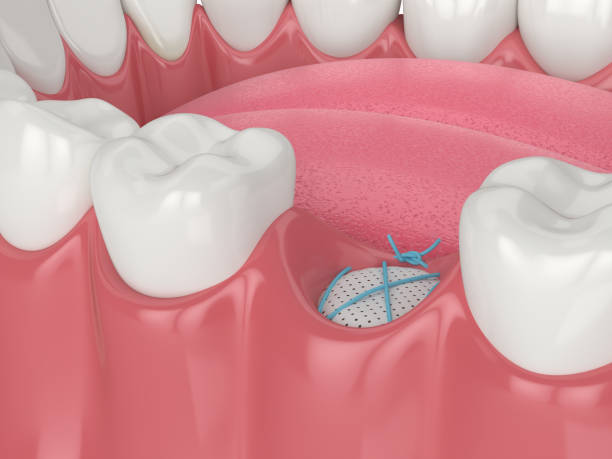
A periodontist decides whether a bone graft is ready for dental implants by examining how the site has healed. Time since surgery is only one factor. The exam checks gum health, the width and height of the rebuilt bone, and any signs of infection. When needed, dental X-rays or 3D imaging show the bone beneath the gums. Together, these findings reveal whether the site can support your planned implant.
Patients often ask three questions after grafting. How long does healing take? Is my bone graft ready for dental implants? What happens if the site needs more time?
Bone grafting can rebuild or preserve jawbone after tooth loss, periodontal (gum) disease, injury, or other causes of bone loss. Many patients need bone grafting before dental implants so the implant has a stable foundation. Understanding the evaluation can make the wait feel more predictable as you prepare for dental implants in Alexandria, VA.
What Happens to a Dental Bone Graft as It Heals?
A bone graft is not finished on the day it is placed. It starts a process of bone regeneration that continues for months as your body builds new bone in and around the graft. For a closer look at the biology, our guide explains how bone grafts heal and remodel over time.
How New Blood Vessels and Bone Cells Support Graft Healing
Healing begins with blood supply. In the first weeks, new blood vessels grow into the grafted area. This process is called vascularization, or angiogenesis. These vessels deliver the oxygen, nutrients, and cells that build bone.
Among those cells are osteoblasts, which lay down new bone tissue. Depending on the graft material and procedure, new bone may grow around the graft particles or throughout the grafted area.
How Graft Material Becomes Incorporated Into the Jawbone
Most graft materials act as a scaffold. Your bone cells use that framework as a guide for growth, a property called osteoconduction. Over time, new bone connects the graft to the surrounding host bone.
Graft materials do not all behave the same way. Some break down and are replaced by new bone fairly quickly. Others resorb slowly, and residual particles may remain inside mature, healthy bone. This incorporation pattern is normal and does not mean the graft failed.
Why Bone Maturation Continues After the Gums Have Healed
Gum tissue usually closes over a graft within a few weeks. The bone underneath heals much more slowly as it forms, mineralizes, and remodels into stronger tissue.
That is why a graft site can look healed long before it is ready for an implant. Healthy-looking gums are a good sign, but your periodontist needs to look deeper before planning surgery.
How Long Does a Bone Graft Need to Heal Before Dental Implant Placement?
Every patient heals on a different schedule. Bone graft healing before dental implants depends on the type of graft, the size of the area being rebuilt, and your overall health. Your periodontist uses general planning ranges as a starting point, then adjusts based on what each follow-up exam shows.
Here is how common grafting procedures generally compare:
| Procedure | What It Does | General Planning Approach |
|---|---|---|
| Socket Preservation | Preserves the ridge after a tooth extraction | Often reassessed after about 3 to 6 months |
| Ridge Augmentation | Rebuilds lost bone width or height | Usually needs a longer healing period and closer monitoring |
| Sinus Lift Bone Graft | Adds bone height in the upper back jaw | Depends on the technique and how much bone is added |
Typical Healing Times After Socket Preservation
Socket preservation, also called ridge preservation, places graft material into the socket right after a tooth is removed. The goal is to limit shrinking of the alveolar ridge, the bone that supports your teeth. You can read more about socket preservation after a tooth extraction and how it protects future implant sites.
For many patients, implant placement may be considered about 3 to 6 months after socket preservation. This is a common planning range, not a fixed date.
Why Larger Ridge Augmentation Procedures May Require More Healing Time
Ridge augmentation rebuilds bone that has already been lost. Horizontal augmentation restores width, and vertical augmentation restores height. These procedures often use more graft material. Some also cover the graft with a protective membrane, an approach called guided bone regeneration.
Larger rebuilds usually need longer healing and closer monitoring because a bigger defect takes more time to fill. The graft material, how well the gums stay closed, and the surgical approach also shape the timeline.
What Can Affect the Speed of Bone Graft Healing?
These factors can influence how quickly a graft matures:
- Smoking and tobacco use: Tobacco reduces blood flow to healing tissue, which can slow new bone formation.
- Uncontrolled diabetes: High blood sugar can slow healing and raise infection risk. Well-managed diabetes is usually easier to plan around.
- Infection at the graft site: An infection can disrupt bone formation and may need treatment first.
- Oral hygiene and periodontal health: Plaque and active gum disease can irritate the healing area.
- Certain medications: Some medications affect bone healing, so your periodontist will review your medical history.
- Graft characteristics and individual response: The material, the size of the grafted area, and your own healing pattern all play a role.
No single factor automatically rules out implant treatment, and age alone does not decide whether a graft will succeed.
How Do Periodontists Examine a Healed Bone Graft Before Implant Surgery?
A bone graft evaluation combines a hands-on exam, measurements, imaging, and treatment planning. Each step helps answer one question: is your bone graft ready for dental implants?
Checking Gum Healing and the Condition of the Grafted Site
The exam starts with the soft tissue. Your periodontist checks whether the gums have fully closed over the graft. They look for redness, swelling, tenderness, or drainage that could signal infection.
They also check for exposed graft particles or membrane material, along with any other changes at the site. Exposure does not always mean a problem, but it needs attention before implant planning moves forward.
If you have no pain or swelling, that is encouraging. Still, feeling fine is not proof that the bone is ready.
Measuring Jawbone Width and Height for Implant Placement
Next, your periodontist evaluates the size of the rebuilt ridge. These measurements come from imaging and the clinical exam, and they are compared with your planned implant. Two measurements matter most:
- Buccolingual width: This is the thickness of the bone from the cheek side to the tongue side.
- Vertical height: This is how tall the bone is from the top of the ridge to nearby anatomy.
That nearby anatomy includes the sinus in the upper jaw and the nerve canal in the lower jaw. The implant needs a safe distance from each one.
No universal minimum measurement fits every case. The right dimensions depend on the planned implant’s size, location, and angle.
Using Dental X-Rays and CBCT Imaging to Evaluate the Grafted Area
Conventional dental X-rays give a two-dimensional view of the graft and surrounding bone. They help track healing and compare the site over time.
When more detail is needed, your periodontist may recommend a cone-beam computed tomography (CBCT) scan. This 3D imaging shows the ridge’s width, height, and shape from several angles. It also maps nearby structures, which supports precise implant planning.
CBCT has limits, though. It cannot prove on its own that a graft has fully matured, and it does not precisely measure bone strength. Research on CBCT bone density measurement explains that CBCT grayscale values are not a reliable substitute for Hounsfield units, the standardized density scale used by medical CT scanners.
Evaluating Bone Quality and the Potential for Implant Stability
Bone quantity is only part of the picture. Your periodontist also considers bone quality for dental implants, which describes how dense and well-structured the bone is. They combine imaging, anatomy, and your healing history to estimate how well the bone will hold the implant.
That initial hold is called primary stability. It is the mechanical grip an implant has the moment it is placed, before new bone grows onto its surface.
Primary stability can be estimated during planning, but it is only confirmed during surgery as the implant is placed. That is why it cannot always be guaranteed ahead of time.
Deciding Whether Additional Healing or Grafting Is Needed
After the exam and imaging, your periodontist decides how to proceed. If the findings are favorable, implant planning moves forward. The plan may change if the bone is still too narrow or short, or if the graft healed less than expected. Signs of infection or another concern can also change the plan.
Possible next steps include:
- Waiting longer: The site gets more healing time, followed by another evaluation.
- Adding more graft material: A second procedure builds up the areas that still fall short.
- Adjusting the implant plan: The implant’s size, position, or timing is modified to fit the available bone.
None of these steps is automatic. Your periodontist recommends the option that fits your specific site.
What Makes a Bone Graft Ready to Support a Dental Implant?
A graft that heals without complications is not automatically ready for an implant. Readiness means the site meets the needs of your specific implant plan. In general, periodontists look for three things.
Sufficient Bone Volume Around the Planned Implant
The implant needs enough bone on all sides to stay stable. Adequate width and height let it sit in the right position for your future crown and bite. A thin layer of bone around an implant can be harder to maintain over time.
Your periodontist plans the implant around where your new tooth needs to be, not just where bone happens to be. That is why bone volume is judged against the planned position. Our guide to precise implant positioning explains how placement affects bite function and comfort.
Healthy Gum Tissue and No Active Infection
Healthy, stable gum tissue helps protect the bone around an implant. Any active gum disease or infection should be treated before surgery. Plaque levels also need to be manageable with your daily care.
Clinical health is different from appearance. Gums can look pink and smooth yet still bleed when gently probed or show deep pockets during an exam. Your periodontist checks tissue health directly, not just how it looks.
A Treatment Plan That Supports Primary Stability and Future Osseointegration
A ready site allows your periodontist to plan for good primary stability. It also sets up the right conditions for osseointegration, the process in which bone gradually fuses to the implant surface.
Graft healing and implant integration are two separate stages. Graft healing builds the foundation before surgery. Osseointegration happens after the implant is placed and follows its own healing timeline. Our article on implant stability and osseointegration explains how these stages work together.
What Happens if Your Bone Graft Is Not Ready for an Implant?
Hearing that your graft needs more time can be frustrating. It does not mean your treatment has failed. Many patients who need extra healing or added grafting can still move forward with implant treatment.
When a Periodontist May Recommend Waiting Longer
Sometimes a graft is healing well but simply needs more time. The bone may still be maturing, or imaging may show that the site is close but not quite ready. In these cases, your periodontist may suggest waiting and scheduling another evaluation.
How much extra time you need depends on what the exam shows. No standard extension applies to everyone.
When Additional Bone Grafting or Ridge Augmentation May Be Necessary
If the ridge is still too narrow or short, more grafting may help. A second procedure may also be needed when part of the graft did not integrate or a complication affected healing. Ridge augmentation in Alexandria, VA, can rebuild the remaining bone before implant placement.
Additional grafting is a recognized part of implant planning. Even when a first graft heals well, some sites still need more bone before an implant can be placed in the right position. If you are considering bone grafting in Alexandria, your periodontist can explain whether a second procedure fits your case.
How Implant Placement Plans Can Change After Reassessment
Sometimes the best path is adjusting the plan rather than adding more bone. Depending on your anatomy, your periodontist may consider:
- A different implant size or length: The implant can sometimes be matched to the bone that is available.
- An adjusted position or angle: Small changes may work if they still support your final tooth.
- Staged surgery: Grafting and implant placement can happen at separate visits.
- A revised restorative sequence: The timing of your crown or bridge may shift, coordinated with your restorative dentist.
These changes are not always appropriate. A smaller implant or different technique only makes sense when it still meets your long-term functional needs.
Why Bone Graft Evaluation Matters for Dental Implants in Alexandria, VA
A careful evaluation helps match the implant to your bone and supports long-term stability.
How a Periodontist Evaluates Bone and Gum Health Together
A periodontist specializes in the gums and bone that support teeth and implants. That training matters after grafting, when both tissues need to be healthy. A periodontist in Alexandria, VA, can assess your graft, gum tissue, any history of gum disease, and implant-site anatomy in a single evaluation.
At Northern Virginia Periodontics, our periodontists are Diplomates of the American Board of Periodontology, which means they hold board certification in periodontics. They plan and perform bone grafting, ridge augmentation, and implant surgery. Patients looking for an implant dentist in Alexandria, VA, may find it helpful to have one team plan the graft and the implant together.
How Personalized Implant Planning Can Reduce Avoidable Complications
Every implant plan should reflect your situation. Planning draws on your imaging, clinical exam, medical history, graft type, and restorative goals, which helps your team spot potential issues before surgery.
Careful planning can lower the risk of avoidable complications, but no implant outcome can be guaranteed. You can explore our approach to dental implants in Alexandria, VA, from single-tooth replacement to full-arch restorations.
When to Schedule a Bone Graft Follow-Up in Northern Virginia
Follow-up timing is individualized. Your periodontist sets a schedule based on the procedure performed and how your site is healing. Our team stays in contact during the healing period to monitor your progress.
Consider scheduling a reassessment if any of these apply to you:
- You had a graft but never completed implant treatment.
- Your implant was delayed, and you are unsure of the next step.
- You have questions or concerns about how your site is healing.
Patients across Northern Virginia can visit our Alexandria or Falls Church office, whichever is more convenient.
Frequently Asked Questions About Bone Graft Healing Before Dental Implants
How can a dentist tell if a bone graft has healed enough for an implant?
A periodontist examines the gums for full closure and signs of infection. They measure the ridge’s width and height against the planned implant. X-rays or a CBCT scan show the bone beneath the gums when needed. They also plan for appropriate primary stability. Time since grafting is one factor, not the deciding one.
Can a bone graft look healed but still not be ready for an implant?
Yes. The gums heal much faster than the bone beneath them, so the surface can look normal while the bone is still maturing. Your periodontist judges readiness through exam findings and imaging, not appearance. Comparing follow-up images with earlier ones also shows how the bone has changed.
Is a CBCT scan always needed after a dental bone graft?
Not always. Imaging choices depend on your anatomy, the type of graft, and the diagnostic information already available. Some cases can be evaluated with standard dental X-rays and a clinical exam. CBCT is often helpful when precise 3D measurements are needed. It is also useful for viewing nearby structures, such as the sinus or the nerve canal.
What happens if my dental bone graft has not healed properly?
Your periodontist first identifies the cause. They may treat an infection, manage exposed graft material, or allow more healing time. If the bone is still insufficient, additional grafting may be recommended. In some cases, the implant plan can be adjusted to fit the available bone.
Can a dental implant be placed before a bone graft has fully remodeled?
Yes, in some cases. Bone remodeling continues for a long time, and some graft particles may remain for years. An implant may be placed once the site has enough stable bone, even if remodeling is ongoing. Some approaches also place the graft and implant at the same visit. This depends on site conditions and whether appropriate primary stability can be achieved.
Does a healed bone graft guarantee dental implant success?
No. A healed graft creates a stronger foundation, but other factors still matter. After placement, the implant must osseointegrate, or fuse with the bone. Healthy gums, good daily hygiene, and regular maintenance visits all support long-term results. Controlling risk factors such as smoking also helps.
Schedule a Bone Graft Evaluation for Dental Implants in Alexandria, VA
If you have had a bone graft or are considering implants after bone loss, a consultation can show where you stand. Our board-certified periodontists review how your graft has healed, examine your gums and bone, and use imaging when needed. We then explain whether your bone graft is ready for dental implants or which next step makes sense.
We welcome patients at our Alexandria and Falls Church offices. You can schedule a bone graft evaluation to review your healing and discuss a personalized plan for your implant treatment.
